GEO / AEO / AIO: What Are They and How Can You Prepare for the Era of AI Search?

Search is changing. With the rise of AI chatbots such as ChatGPT, Gemini, Claude, and others, fewer and fewer users are turning to Google. And when they do use Google, many searches no longer return just a list of links. Instead, users may also get a direct AI-generated answer, similar to what they would see in ChatGPT. This is significantly changing how people find information, browse products and services, and discover new brands.
For businesses, this does not mean that traditional SEO is becoming obsolete. Rather, website optimization is gaining an additional layer. It is no longer enough to think only about your position in search results. You also need to consider whether AI systems can understand your content, use it, summarize it, cite it, or recommend it as a relevant source.
In this article, we’ll explain what AI search is, how it works, and what the increasingly common acronyms GEO, AEO, and AIO mean. Instead of hype and alarmist claims such as “SEO is dead,” we’ll offer a practical way to think about website visibility in this new era of search.
Table of Contents
- What Is AI Search?
- Traditional SEO vs. AI SEO: What Stays the Same and What Changes?
- How Does AI Search Affect Website Traffic?
- Which Types of Content Are Most Vulnerable in the Era of AI Search?
- What Type of Content Works Best?
- How to Optimize a Website for AI Search
- The Most Common Mistakes in AI Search Optimization
- A Practical Optimization Process
- Conclusion
What Is AI Search?
AI search is a way of searching in which the system does not simply show the user a list of results, but instead tries to generate an answer directly. Examples include Google AI Overviews, Google AI Mode, Bing Generative Search, Perplexity, or responses from AI tools that work with web sources.
Users no longer necessarily have to visit multiple pages and piece together an answer themselves from sources they consider relevant. AI can find relevant information, compare it, and present the resulting answer directly to the user, sometimes supplemented with links to the original sources.
Imagine an online store selling gardening supplies. With traditional search, a user might type “what fertilizer should I use for raspberries?” and open several articles or product categories. With AI search, they may instead receive a summary explaining that raspberries need fertilizer with a higher potassium content, and that the right type of nutrition may differ depending on whether they are grown in containers or in a greenhouse. Only then does the user decide whether to click through to a specific source, product, or category.
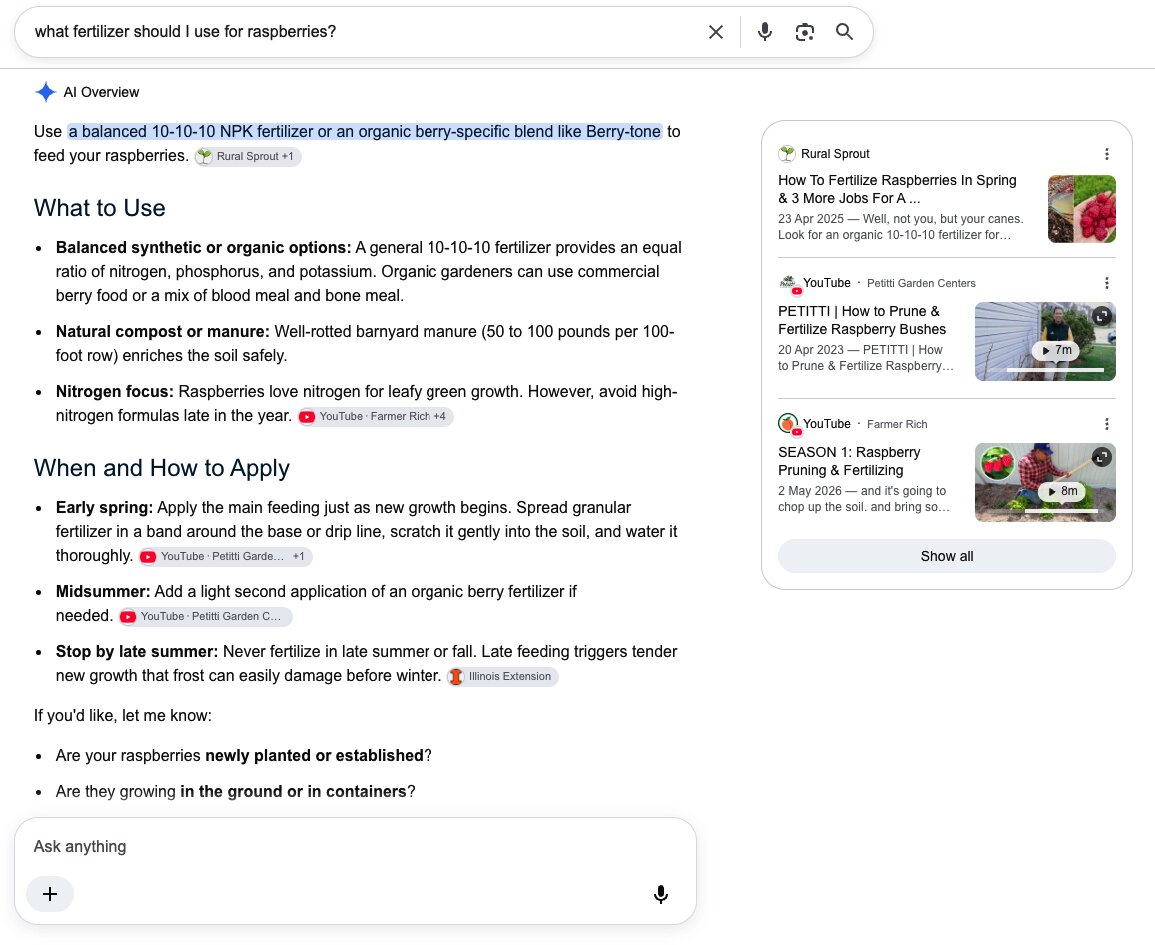
Screenshot of an AI-generated Google response to the query “what fertilizer should I use for raspberries?”
From an SEO perspective, it is important to understand that visibility is not simply shifting from a “ranking position” to an “answer.” In practice, there are now more places where a website can appear: as a traditional organic result, as a cited source in an AI-generated answer, as a product result, or as a brand mentioned by the AI system in the context of a recommendation.
How Does This Type of Search Work?
AI search usually begins in much the same way as traditional search: the user asks a question or enters a query. If they are not using Google, they may ask Gemini, ChatGPT, Claude, Perplexity, or another chatbot instead.
Unlike traditional search, an AI system does not simply try to rank results by relevance. It attempts to understand the intent behind the question, find related information, and generate an answer that is as helpful to the user as possible.
To understand this a little better, it helps to know two important concepts: retrieval-augmented generation (RAG) and query fan-out. Retrieval-augmented generation means that an AI-generated answer can be grounded in retrieved, up-to-date web sources. Query fan-out means that AI can turn the original question into several related subqueries in order to cover the topic more broadly. Don’t worry, that’s as technical as we’ll get.
If a user asks, “how do I establish a lawn on clay soil?”, the AI does not necessarily search only for that exact phrase. It may break the topic down into subquestions: how to improve clay soil, what type of sand or compost to use, when to sow grass seed, how to prepare the ground, how often to water, and what common mistakes to avoid when establishing a lawn. A website that covers these subtopics clearly and credibly is more likely to be useful to an AI system.
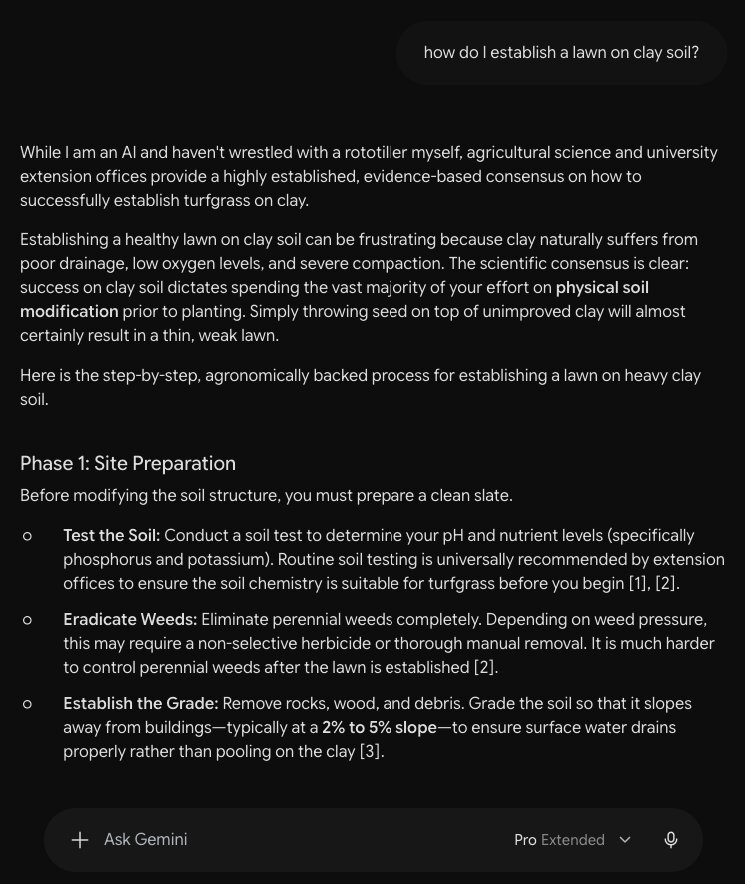
Screenshot of a Gemini response to the query “how do I establish a lawn on clay soil?”
This means that content should not answer only one narrowly defined search phrase. It should cover the user’s broader decision-making context. For a gardening e-commerce store, for example, having only a “fertilizers” category is not enough. It is more useful to also provide advisory content explaining which fertilizer to choose for tomatoes, lawns, herbs, houseplants, or fruit trees – and to link that content to relevant products.
GEO, AEO, AIO: What Do These Acronyms Mean?
The acronyms GEO, AEO, and AIO emerged in response to the fact that search is no longer just about ranking links. In marketing practice, they are often used to describe optimization for AI-generated answers, generative search, or AI summaries displayed in search results.
The most practical way to think about them is as three different perspectives on a similar problem. AEO asks whether your content can provide a clear answer. GEO asks whether your content can be used or cited in a generative response. AIO asks how to prepare a website for an environment in which AI plays a growing role in search, recommendations, and user decision-making.
GEO — Generative Engine Optimization
GEO stands for Generative Engine Optimization, meaning optimization for generative search systems. The goal is not only to achieve a higher position in a traditional SERP, but also to increase the likelihood that a generative system will use, correctly interpret, mention, or cite your content in its response.
If traditional SEO asks, “How can I rank higher in search results?”, GEO asks, “How can I become a trustworthy source for an answer that AI assembles from multiple sources?” A website is therefore no longer competing only for a click, but also for inclusion in the answer itself.
GEO is therefore not simply about including the right keywords in a piece of content. Structure, accuracy, expertise, specificity, and the ability to answer related questions all matter. The more clearly content is divided into understandable sections and the more genuine value it provides, the easier it is for AI systems to use it as a source when generating an answer.
AEO — Answer Engine Optimization
AEO stands for Answer Engine Optimization, or optimization for answer engines. It is based on the idea that users often do not want to read an entire article, but instead want a specific answer: what to buy, how to do something, when the right time is, what the difference is between two options, or what a particular term means.
In traditional SEO, AEO was most commonly associated with featured snippets, FAQs, voice search, or concise answers displayed directly in search results. In the era of AI search, this principle has expanded: clear answers are useful not only for users, but also for systems that assemble responses from existing content.
Good AEO means that important information is stated directly, precisely, and in a logical order. The reader can reach the answer quickly while still having the option to continue into a deeper explanation if they need more context to make the right decision.
AIO — AI Optimization / AI Overview Optimization
AIO is a less established term than GEO or AEO. In practice, it is used in two ways. Sometimes it refers broadly to optimization for AI. In other cases, it is used more specifically to mean AI Overview Optimization, meaning optimization for situations in which Google displays an AI-generated summary directly in search results.
If we understand AIO specifically as optimization for Google AI Overviews, then it is not a separate trick or a special type of markup. Google states that its core SEO recommendations remain relevant for AI Overviews and AI Mode: ensuring that content can be indexed, creating high-quality content, providing a good user experience, using internal links, making important content available in text form, and using structured data where it accurately reflects the visible content.
Traditional SEO vs. AI SEO: What Stays the Same and What Changes?
AI SEO is not a replacement for traditional SEO, but an extension of it. You still need an indexable website, high-quality content, strong internal linking, fast load times, and trustworthiness. What is changing is that users no longer necessarily need to click through to your website to get an answer. They may receive part of that answer directly in search results or within an AI tool.
In traditional SEO, the typical goal is to rank a page as highly as possible and earn a click. AI SEO adds another objective: becoming a source that an AI system uses when generating an answer. Sometimes this may lead to a click; other times, it may result only in a mention, citation, or indirect exposure to your brand. That also changes how we need to think about the value of content.
For a gardening e-commerce store, this means that simply optimizing a “fertilizers” category for a target keyword is no longer enough. The website should also be able to answer the questions customers ask before making a purchase: what fertilizer to use for tomatoes, what to fertilize a lawn with after winter, how often to fertilize potted plants, and so on.
What Stays the Same?
The fundamental principles of SEO are not changing. In its documentation on AI Overviews and AI Mode, Google states that established SEO practices remain relevant for AI features in search. A website still needs to be technically accessible, indexable, well connected through internal links, and designed to provide a good user experience.
Search intent remains just as important. If a user searches for “best hedge trimmers,” they are not looking for a general essay about garden tools. They want to compare different types of hedge trimmers, understand the differences between manual, electric, and cordless models, and find out which option is suitable for thin branches versus regular maintenance of a dense hedge.
Trustworthiness also remains essential. Content that is inaccurate, generic, lacks a clear author, provides no practical experience or examples, and has no clear purpose will be less valuable both to users and to AI systems.
What Changes?
What changes most is the way answers are assembled and presented. With traditional search, users see a list of results, compare headlines, and click through to a website. With AI search, the system may perform multiple related searches, extract information from several sources, and assemble an answer before the user ever visits a specific website.
This means content needs to work better as a source. It is not enough to have a long article that hides the answer somewhere in the middle of the text. Important information should be clearly stated, divided into logical sections, and supported with examples, tables, or decision-making criteria. This kind of structure is also valuable for the human reader who clicks through to your website from an AI-generated result.
A weak article might say: “You should fertilize your lawn in spring.” A stronger article explains when to fertilize after winter, how to recognize nutrient deficiencies, when to aerate the lawn first, and other relevant considerations. This type of content covers the full decision-making context much more effectively.
How Is Success Measured Differently?
In traditional SEO, success has often been measured through rankings, organic traffic, CTR, and conversions. These metrics remain important, but in AI search they may no longer tell the whole story. A page may receive more impressions but fewer clicks. Or it may lose some informational traffic while attracting a smaller number of higher-quality visitors with clearer intent.
That is why it is also useful to monitor broader signals: whether your brand appears in AI-generated answers, whether your website is cited as a source, how the relationship between impressions and clicks changes in Google Search Console, whether branded search volume is growing, and whether the traffic that does reach your website actually leads to conversions. In AI SEO, success is not only about traffic volume, but also about the quality of your visibility.
For example, a gardening e-commerce store may see traffic decline to an article titled “what is mulching?” because an AI-generated answer explains the concept directly within the conversation or search result. On the other hand, a query such as “what type of mulch should I use for strawberries, ornamental shrubs, and fruit trees?” may still bring in customers who are already considering a specific purchase and need help choosing the right product.
How Does AI Search Affect Website Traffic?
The reality is more complicated than saying that “AI is taking away all organic traffic.” For many years, search was understood primarily through the logic of Google organic search: a user enters a query, sees a list of results, clicks one of them, and lands on a website. AI search makes that journey more complex.
A user may get an answer directly in Google, ask ChatGPT or Perplexity instead, and then continue with follow-up questions. They may only visit a website when they need more detail (people do not fully trust AI), want to view a product, make a simple comparison, or consult a trustworthy source.
It is therefore useful to distinguish at least three types of impact:
- fewer clicks from Google for simple informational queries;
- new referral traffic from AI chatbots; and
- growth in “invisible” visibility, where a brand appears in an AI-generated answer but the user does not immediately click through to the website.
We will look at each of these in more detail below.
AI Answers in Google and Their Impact on Click-Through Rates
The most widely discussed impact of AI search is the decline in clicks from Google for queries where users receive an answer directly in the search results. AI summaries do not yet appear for every query, but when they do, the impact on clicks can be significant.
In an analysis of Google searches conducted in March 2025, Pew Research Center found that users were less likely to click a traditional search result when an AI summary appeared. On pages with an AI summary, users clicked a traditional result in 8% of visits, compared with 15% on pages without an AI summary.
In an analysis published by Ahrefs in December 2025, CTR was compared with the same period in 2023. The analysis found that when an AI Overview appeared, click-through rates for the top-ranking page were up to 58% lower.
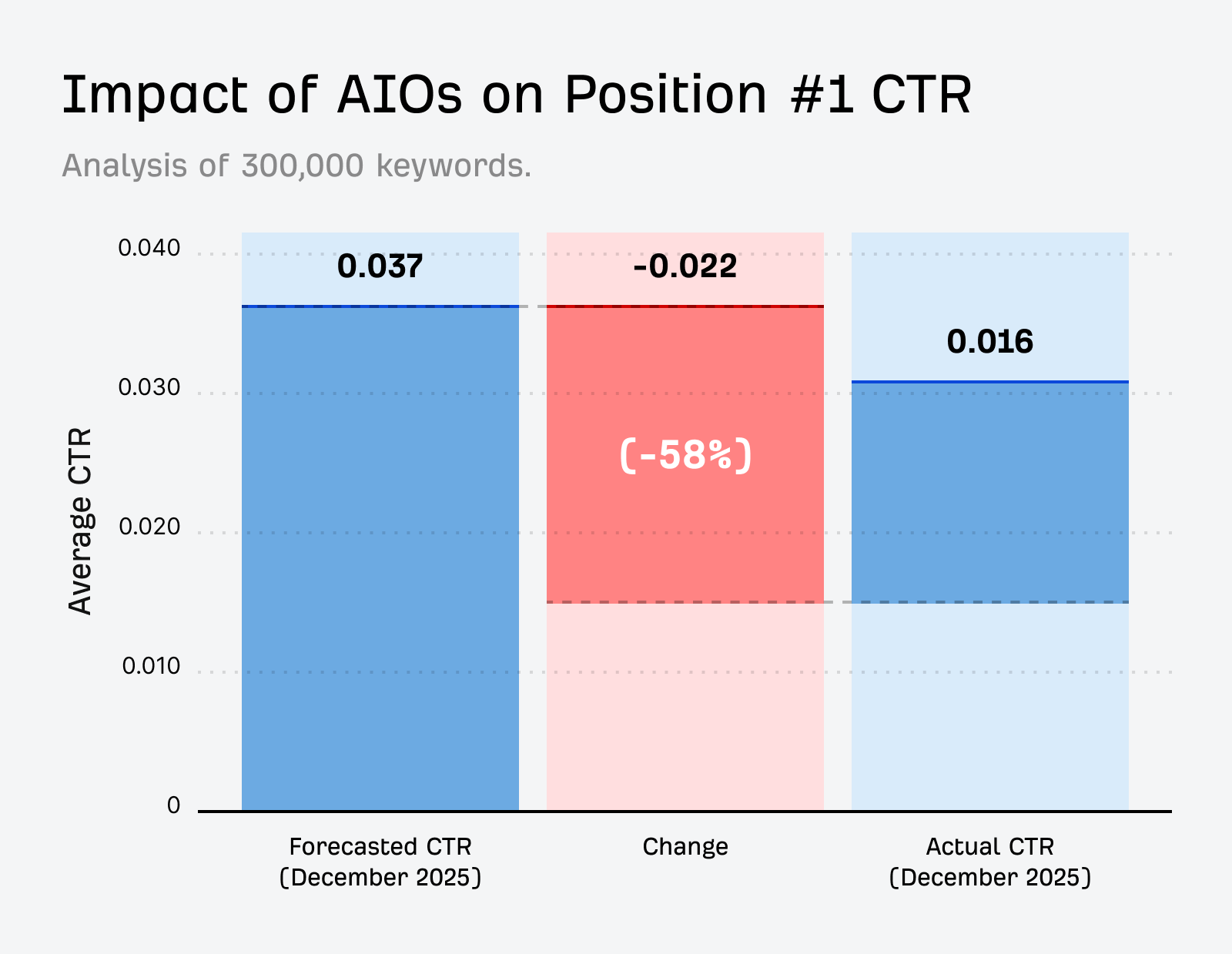
Visualization comparing CTR in December 2025 with the previous comparison period. Source: Ahrefs
Chatbots Are Becoming a New Source of Website Traffic
The second major change is that some users are no longer looking for answers only on Google, but directly within AI chatbots. ChatGPT, Perplexity, Copilot, and Gemini are changing search behavior by allowing users to ask questions conversationally, follow up on them, and gradually refine their intent.
AI chatbots often provide links to relevant web sources or directly recommend products from specific retailers. This means that a chatbot is not merely a tool for generating text; in some situations, it also acts as an interface for discovering content on the web.
For websites, this creates a new type of traffic: AI referral traffic. Instead of arriving through a traditional organic search result, the visitor comes from a link in an AI-generated response. According to a 2026 Semrush analysis, AI traffic grew throughout 2025 but still accounted for less than 0.15% of total website visits in the dataset analyzed. AI referral traffic is growing, but it is not yet capable of replacing Google organic traffic at a comparable scale.
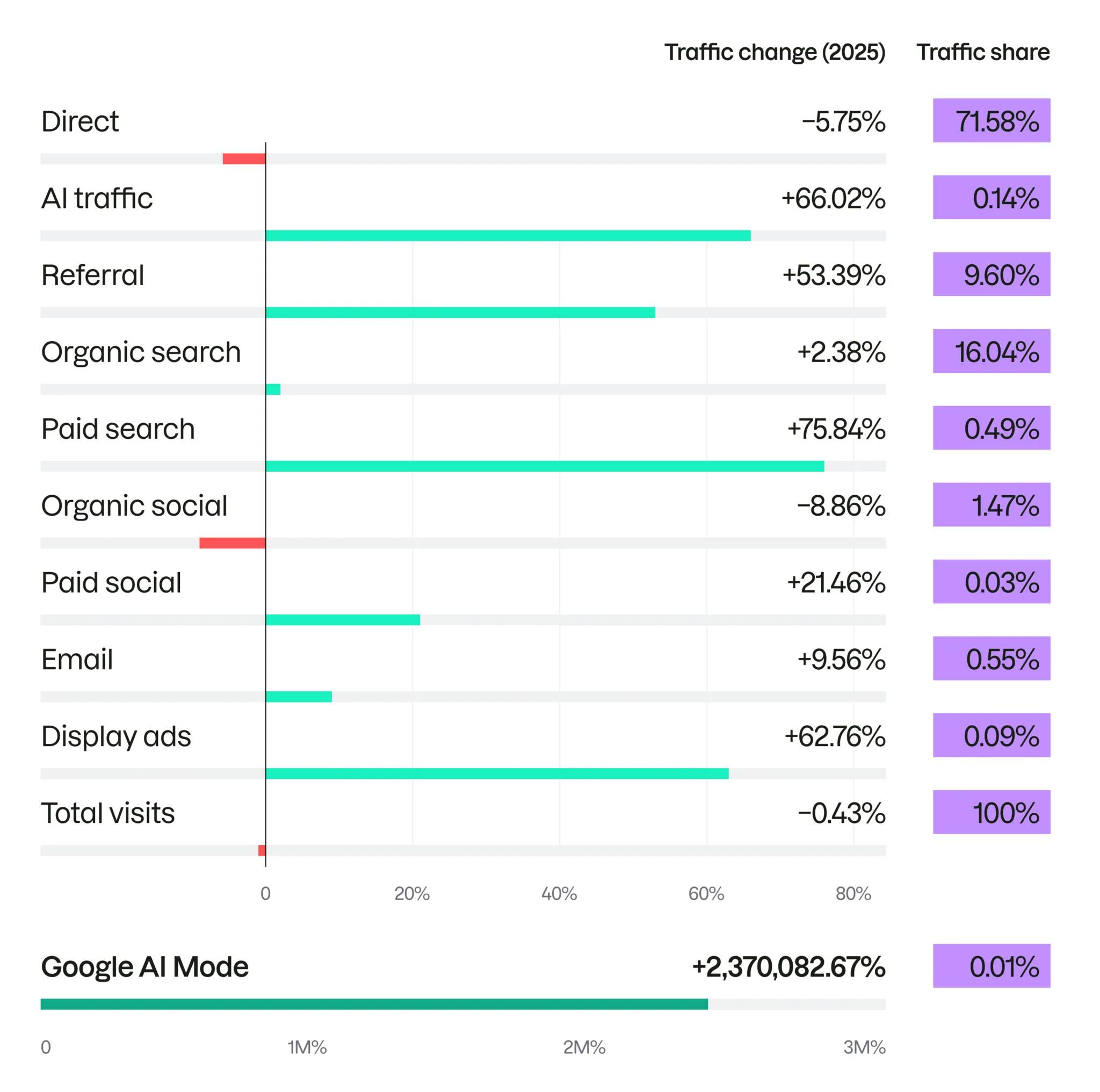
Website visits by traffic source. Source: Semrush
From a strategic perspective, this means businesses should not treat AI chatbots as an immediate replacement for SEO. They are better understood as an additional channel of visibility. Today, they may account for only a small share of total traffic, but for certain types of topics, particularly research, comparisons, how-to content, and more complex purchase decisions – their commercial value may be greater than the raw traffic numbers suggest.
Google and Chatbots Should Not Be Measured the Same Way
It is important not to combine all AI-related effects into a single metric. Google AI Overviews and AI Mode are still part of the Google Search ecosystem. Performance in these AI features is reported in Search Console under the “Web” search type, alongside other search results. This means that Search Console currently does not allow you to distinguish a click from a traditional search result from a click originating in an AI Overview.
Chatbots are different. Visits from ChatGPT, Perplexity, Copilot, or other AI tools may appear in analytics as referral traffic when a user clicks a link and the tool passes referrer information. These traffic sources should therefore be monitored so that AI referrals do not become a new blind spot in analytics.
Fewer Visits Do Not Necessarily Mean Worse Results
For some topics, AI search may reduce the number of website visits while increasing their quality. According to Google, clicks from AI Overviews are higher quality because users have more context before clicking. This should, however, be treated as a claim from the platform itself rather than independent evidence that applies to every website. Strategically, it is becoming increasingly important to place more emphasis on conversions than on the sheer volume of organic visits.
If a user reaches a website only after reading a basic explanation in an AI-generated answer, they may already be further along in the decision-making process. They are no longer searching only for “what is potting soil?”, but rather “which potting soil should I buy for…?” This type of visitor is not simply looking for information, they are already considering a purchase.
The goal therefore should not be to protect every single click to informational content. It is more important to distinguish between pages that generate commercial value, pages that build trust, pages that answer pre-purchase questions, and pages that provide little more than generic definitions without additional value.
Which Types of Content Are Most Vulnerable in the Era of AI Search?
The most vulnerable content is content that adds nothing beyond information that is already widely available. If an article simply defines a term, repeats generic advice, or rewrites what can already be found on dozens of other websites, AI may be able to give the user a similar (or even better) answer directly within the conversation. This type of content was already weak from a traditional SEO perspective, but AI search makes those weaknesses even more visible.
In its guidance on optimizing for AI features, Google explicitly recommends creating non-commodity content that offers a unique perspective, first-hand experience, or meaningful value to the reader. This is especially important in topics where many websites publish very similar articles simply to target keywords.
Short Definitions Without Added Value
Articles such as “What Is Compost?”, “What Is Mulch?”, or “What Is Perlite?” can still serve a purpose, but on their own they are often not enough. If the content stops at a basic definition, an AI-generated answer can easily replace it. A user is unlikely to click through to a website if they already received a concise explanation directly in the answer.
A better approach is to expand the definition with practical context. In an article about perlite, for example, an e-commerce store could explain when to use it, what ratio to mix it with potting soil, which plants it is suitable for, when an alternative may be a better choice, and what mistakes beginners commonly make when growing houseplants. At that point, the article is no longer answering only “what is it?” – it is helping the user make a decision.
Generic How-To Content Without First-Hand Experience
Generic guides that lack practical experience are also vulnerable. A typical example is an article titled “5 Tips for Taking Care of Your Garden in Spring” that contains only broad recommendations: clean up the garden, fertilize the lawn, prune plants, and prepare your tools. This kind of content is easy to replace because AI can summarize similar advice from many different sources.
A more valuable guide goes deeper. For example, “Spring Lawn Care After Winter: What to Do Based on Soil Conditions and Damage” could distinguish between a waterlogged lawn, moss, bare patches, compacted soil, and frost damage. This type of content has greater value because it helps the user diagnose a problem rather than simply read generic advice.
Content Without Credibility or a Clear Author
In AI search, content that lacks signals of source credibility can also be at a disadvantage. If a page does not identify its author, show when it was last updated, cite sources, or otherwise sounds generic, why should a user (and by extension an AI system) trust it? Credibility becomes even more important in topics where incorrect advice could cause harm.
Google has long placed strong emphasis on trustworthiness because recommending unreliable websites can also damage the quality and credibility of its own search results. AI chatbots face a similar challenge: they also have reputations to build and protect, and many of the same principles around reliable sourcing apply to them.
What Type of Content Works Best?
In the era of AI search, the content that performs best is clear, practical, trustworthy, and difficult to replace with a simple summary. Length alone is not what matters. A long article can still be weak if it is difficult to navigate and simply repeats generic advice. A shorter article can be much stronger if it answers the question precisely, adds first-hand experience or comparison, and helps the reader make a decision.
In the context of AI search, this primarily means creating content that offers more than a paraphrase of information that already exists elsewhere. Strong content has its own perspective, specific examples, a clear structure, and practical value.
AI search is designed to identify the content that is most useful to people. So content should not be created for AI, but for humans. Ask yourself: when was the last time an article, product page, or landing page genuinely stood out to you because of its content?
Content That Covers the Entire Decision-Making Context
The strongest content does not answer only the user’s initial question, but also the questions that are likely to follow. Someone searching for “what fertilizer should I use for tomatoes?” will probably also want to know when to fertilize, how often, whether to use liquid or granular fertilizer, what changes when growing tomatoes in containers, and what signs indicate a nutrient deficiency.
This type of content is well suited to AI search because it better reflects the way AI systems can break more complex questions down into related subtopics. At the same time, it is also better for the user because it saves time and helps them make the right decision without having to open five different articles.
Content With Comparisons, Tables, and Practical Recommendations
Comparisons and decision-making frameworks can be particularly effective. For our frequently mentioned gardening e-commerce example, these might include articles such as “Wood, Metal, or Plastic Raised Beds: Which Should You Choose?”, “Manual, Electric, or Cordless Sprayer?” or “Expanded Clay vs. Perlite: When Should You Use Each?”
Comparison content is valuable because it helps users choose between alternatives. It also gives AI systems clear criteria that can be extracted and compared more easily: price, lifespan, maintenance, suitability for beginners, suitability for a small garden, potential drawbacks, and typical use cases. This kind of content is more useful than a generic article that simply lists a product’s advantages.
Content Based on First-Hand Experience, Expertise, and Evidence
The hardest content to replace is content built on first-hand experience, genuine expertise, or original data. For an e-commerce store, this could include product testing results, recommendations based on the most common customer questions, photos showing products in real-world use, seasonal recommendations, or practical advice drawn from experience.
One example might be an article titled “The Most Common Mistakes When Growing Tomatoes in Containers, Based on Questions From Our Customers.” This type of article is more valuable than generic content because it is based on real problems raised by real customers. There is no identical copy of that article anywhere else on the internet.
How to Optimize a Website for AI Search
Optimizing for AI search does not rely on any magic trick. As we have already discussed in this article, it is still built primarily on the principles of traditional SEO: indexability, technical accessibility, useful content, authority, and a clear website structure remain the foundation.
What changes is the emphasis. In AI search, content should not only be optimized around keywords, but also be easy to understand, clearly divided into meaningful sections, and specific enough for an AI system to use when generating an answer. Good optimization therefore addresses not only the question “What do we want to rank for?” but also “How does our content actually help the user?”
1. Start With Search Intent, Not Just Keywords
This does not mean keywords no longer matter, but they are no longer the only focus. AI works more with the meaning of a question, its context, and related subquestions. This is connected to the principle of query fan-out, where a system may turn one question into several related queries to better understand and cover the user’s intent. We explained this principle in more detail earlier in the article.
When creating content, do not start only with the question “Which keyword has search volume?” Also ask:
- What is the person trying to solve at this moment?
- What do they probably already know?
- What is still unclear to them?
- What concerns do they have?
- What criteria will they use to make a decision?
In an AI search environment, search intent expands from a single phrase into the user’s broader decision-making context.
If someone searches for “what fertilizer should I use for tomatoes?”, they probably do not want only a list of products. They may also need to know when to start fertilizing after planting, the difference between organic and mineral fertilizer, what potassium deficiency looks like, how to fertilize tomatoes grown in containers, and so on.
A practical approach is simple: create a question map for every important topic. The main question might be “what fertilizer should I use for tomatoes?” Subquestions could include “when should I fertilize?”, “how often should I fertilize?”, “what dosage should I use?”, and so on. This allows you to cover the topic comprehensively rather than only at a superficial level.
2. Write Answers That Make Sense Even Out of Context
AI systems and human readers often work with excerpts of content. Important passages should therefore make sense even when read on their own. This does not mean writing short or superficial answers. It means that every important section should have a clear point, a precise answer, and then a more detailed explanation.
A weak answer would be: “It depends on the type of plant and the conditions.”
A better answer would be: “Do not apply a strong fertilizer to tomatoes immediately after planting. Give them time to establish their roots first, then choose nutrition based on the growth stage: plants need different support during leaf growth than during flowering and fruit production.”
An answer like this is easier for an AI system to use and also provides more value to the reader.
A useful rule when writing an article is to start with a short answer, continue with an explanation, add an example, and finish with a practical recommendation. This format works well for readers because they can quickly understand the main point. It is also suitable for AI search because the content is clearly structured and semantically easy to interpret.
3. Structure Content Into Logical Sections
A long, unstructured block of text is difficult for both users and search systems. Write content so that it is easy to read, divided into paragraphs and sections, with headings that create a clear hierarchy using H1–H6. This is a basic but often underestimated part of AI optimization.
Good structure does not simply mean adding more headings. It means that each section has a clear purpose:
- A definition explains a concept.
- A comparison helps the user choose.
- A checklist helps verify a process.
- A table simplifies decision-making.
- FAQs address follow-up questions.
- An internal link guides the user to a related topic or product.
These elements should also use the appropriate HTML structure so that AI systems and search engines can more easily recognize relationships between different parts of the content.
4. Build Topical Authority, Not Isolated Articles
A single article is rarely enough to make a website appear authoritative on an entire topic. Both AI search and traditional SEO work better when a website covers a subject systematically. This means that important topics should not exist as isolated articles, but as content clusters connected through internal links.
For example, if a gardening e-commerce store wants to build authority around growing tomatoes, it should not rely on a single article titled “How to Grow Tomatoes.” A stronger approach is to create an entire topic cluster covering variety selection, starting seedlings, planting, fertilization, support structures, diseases, container growing, greenhouse growing, common mistakes, and recommended products.
Topical authority also helps users continue their journey. Someone reading an article about fertilizing tomatoes may next need guidance on choosing plant supports, dealing with blight, selecting potting soil for containers, or controlling pests. Internal links should guide them naturally rather than randomly.
It is also important not to go to the opposite extreme: creating dozens of nearly identical pages simply to cover every possible variation of a question. Google warns that producing large volumes of pages primarily to manipulate rankings or generative responses is not a sustainable long-term strategy. It is better to create fewer, higher-quality content assets.
5. Strengthen Content Credibility
Credibility becomes even more important in AI search. Google recommends creating content that is useful, reliable, and primarily intended for people. First-hand experience, expertise, accuracy, and the ability to offer more than a summary of information available elsewhere are particularly important.
Credibility is not created by simply saying “we are experts.” It is supported through clear authorship, update dates, transparent explanations of recommendations, links to relevant sources, customer or client experiences, original photography, testing, comparisons, and practical insights from real-world experience.
For a gardening e-commerce store, a credible article might be titled “The Most Common Mistakes When Growing Herbs on a Balcony, Based on Questions From Our Customers.” This kind of content is more valuable than a generic article because it is based on real problems experienced by real people.
6. Use Comparisons, Examples, and Decision-Making Frameworks
AI search is particularly strong at synthesizing information. It therefore makes sense to create content that helps users compare options and choose based on their specific situation. Users often do not want only a definition. They want to know what is better, cheaper, safer, simpler, or more suitable for their particular problem.
For a gardening e-commerce store, useful comparisons might include “wooden vs. metal raised beds” or “organic vs. mineral fertilizer.” This type of content reaches users during the decision-making stage rather than only during basic information gathering.
A good comparison should go beyond a simple list of pros and cons. AI can generate that kind of content within seconds. Instead, include criteria such as:
- who the solution is suitable for;
- when it is not worth choosing;
- the most common mistakes;
- price differences;
- maintenance requirements;
- what the customer should check before buying;
- ideally, your own experience and/or the experience of your customers or clients.
This type of content helps both the user and the AI system understand the context behind a recommendation.
7. Use Structured Data Where It Makes Sense
Structured data is not a shortcut to better AI-generated answers, but it can help Google and other systems understand the content of a page more clearly. In traditional search, it can also enable certain types of rich results, which may have a positive impact on click-through rates.
Google states that it uses structured data to understand page content and obtain information about entities, products, businesses, and other elements represented on a page.
Websites should use relevant structured data for information such as the organization, its locations where applicable, navigation elements, and other appropriate entities. Article-related structured data can identify the author, description, and other metadata. For e-commerce websites, structured data is particularly important because product markup can include information such as images, price, availability, shipping, return policies, and other relevant details.
Structured data is not visible to users, but it can make it easier for search engines and AI systems to understand the website and obtain a more complete picture of its content. In practice, this may improve the chances of a business being considered for queries such as “where can I buy X right now?” or “I need advice about Y, who can I contact?”
Practical Summary
Optimizing for AI search is not a separate category from SEO. It is a more rigorous version of SEO: a deeper understanding of user intent, clearer answers, stronger structure, greater credibility, and content that genuinely helps users make decisions.
The Most Common Mistakes in AI Search Optimization
The first mistake is assuming that AI SEO replaces traditional SEO. In reality, technical SEO, indexation, internal linking, site speed, information architecture, and high-quality content remain the foundation. If a website is not easy for traditional search engines to access and understand, it will not be well prepared for AI search either.
The second mistake is chasing “shortcuts to success” instead of focusing on the user – which, of course, does not eliminate the need for a strategy. GEO, AEO, and AIO can be useful concepts, but they cannot compensate for weak content. If an article or any other piece of content brings nothing new to the table, it is essentially the same as dozens of competing pages, there is little value in investing significant time and money into optimizing it.
The third mistake is producing large numbers of similar articles for every possible question. With AI search, it can be tempting to create a separate page for every fan-out query, but Google warns that content created primarily to manipulate search rankings or generative responses can be problematic. It is better to build strong topic clusters than an endless collection of thin pages.
The fourth mistake is ignoring credibility. For a gardening e-commerce store, it is not enough to write a generic recommendation such as “use a suitable treatment.” The user needs to know what problem the product is intended for, when to use it, what to check on the label, what its limitations are, and when it is better to address the underlying cause rather than just the symptom. Be as critical of your own content as you are of other people’s – would you trust a cliché with no evidence, practical examples, or expertise behind it?
The fifth mistake is tracking only traffic. In the era of AI search, clicks to simple informational articles may decline, while the quality of visits, branded search, referral traffic from AI tools, or brand visibility within AI-generated answers may change at the same time. If a company looks only at organic visits in Search Console, it will miss part of the picture.
The sixth mistake is separating content from the products or services you actually offer. Websites often create blogs that may generate (or may once have generated) traffic, but do not guide users toward relevant categories, products, or services. In both AI SEO and traditional SEO, advisory content should not be a dead end. It should naturally connect the problem, the solution, and the offer.
A Practical Optimization Process
If you want to prepare a website for AI search, do not start by creating new content blindly. First, you need to understand which parts of the website currently generate traffic, which have commercial value, which are vulnerable to AI-generated answers, and where the site has content or technical gaps.
A good optimization process consists of four steps:
- auditing current organic traffic,
- auditing and updating existing content,
- auditing the website structure, and
- systematically creating new content.
This approach is safer than rushing to rewrite articles simply because a new acronym has appeared.
Audit Your Current Organic Traffic
Start with Google Search Console. Search Console helps website owners understand performance in Google Search and monitor indexation, page performance, queries, clicks, and impressions. In the context of AI search, it is important to monitor not only clicks, but also the relationship between impression growth and changes in CTR.
In practice, divide your pages by type, for example, product or service pages, blog articles, landing pages, informational definitions, and so on. Then identify which pages generate a lot of traffic, which receive many impressions but have a low CTR, which generate conversions, and which attract traffic without contributing meaningful commercial value.
Also monitor referral traffic from AI tools if it appears in your analytics. It may still be small, but it can indicate which types of content AI systems find useful enough to reference. At the same time, regularly test important questions in Google, ChatGPT, Perplexity, or another tool and observe whether your brand appears, whether competitors are mentioned, and what types of sources the AI system tends to favor.
You can track conversions and traffic sources, including referral traffic, using Google Analytics. We assume that you already have both Google Analytics and Google Search Console set up and know how to work with them.
Audit and Update Existing Content
After the data audit comes the content audit. For every important article, ask:
- Does it clearly answer the main question?
- Does it cover likely follow-up questions?
- Does it include a practical example?
- Does it help the user make a decision?
- Is the information up to date?
- Does it have a clear author or credible source?
- Is it connected to relevant products, services, or categories?
Not every product page, article, or landing page needs to meet every single criterion. What matters is that the content is useful, informative, and transparent. The checklist above can help identify gaps that you can then address based on your own judgment.
Often, the greatest opportunity is not in creating new content, but in improving existing pages. An older article with a strong history may only need to be reworked by:
- adding a clear answer near the beginning;
- dividing the text into sections using a logical H2 > H3 > … hierarchy;
- adding a table or images;
- updating information that is no longer relevant;
- adding sources and relevant external links;
- linking the article to appropriate products and services where it makes sense.
If a piece of content is underperforming relative to its potential, avoid limiting yourself to cosmetic changes. Changing the headline, adding a few keywords, or inserting a short FAQ is often not enough. The content may simply not be relevant or trustworthy enough, in which case a more substantial rewrite may be necessary.
Audit the Website Structure
AI optimization is not only about editing text. Website structure also matters. In its guidance for generative AI features, Google emphasizes that technical structure remains fundamental to how it discovers and processes pages. A website needs to be easy to navigate, indexable, and its content should be available in a readable form for people through clear structure and for machines through appropriate technical markup.
When auditing the structure, check whether important pages are buried too deeply, whether articles link to relevant products or services, whether internal links make sense, and whether the website contains too many isolated (orphan) articles or pages without meaningful context. Internal linking is one of the main mechanisms for building coherent topic clusters.
For example, on a gardening e-commerce website, a topic such as “lawn care” should not be scattered across the site without any clear logic. Fertilizer categories, lawn-care articles, moss-control products, lawn mowers, and related resources should be interconnected so that both users and search engines can understand the relationships between them.
At the same time, users should be able to move directly from an article to a relevant product and purchase it, or easily discover additional useful content before making a decision. As we have emphasized several times throughout this article, the goal is not merely to optimize for a particular type of search, but to improve the overall user experience.
The audit should also include technical SEO elements such as:
- indexation;
- canonical tags;
- XML sitemaps;
- duplicate pages;
- orphan pages;
- site speed;
- mobile responsiveness;
- structured data; and
- other relevant technical factors.
Create New Content and Build First-Hand Experience
New content should not be created solely from a keyword list. It should be based on real customer questions, data, seasonality, expertise, practical feedback, and the problems people face before making a purchase. This is one of the key differences between a generic blog and content that continues to provide value in AI search.
For a gardening e-commerce store, customer support questions can be an excellent source of topics: why tomato leaves turn yellow, what to do about moss in a lawn, and similar practical issues.
Content based on first-hand experience is even more valuable. This can include photographs of products being used, comparisons between two types of raised beds, customer feedback, or practical observations about which products are suitable for beginners and which require more experience.
This kind of content takes longer to create than generic articles, but it is also more resilient. An AI system can easily summarize generic advice, but it is much harder to replace genuine first-hand experience.
Conclusion
AI search does not change the fundamental purpose of SEO. It is still about helping the right person find the right answer at the right time. What is changing is the way that answer is presented—sometimes as a traditional search result, other times as an AI-generated summary, citation, or recommendation.
The best way to prepare is not to chase the latest acronym. It is to carry out a thorough website audit, improve content structure, provide more trustworthy answers, add practical examples, and connect educational content with commercial value. Websites that simply repeat generic information will be more vulnerable. Websites that provide genuine value will always have an advantage.
If you want to find out whether your website is ready for AI search, start with an SEO audit. We’ll review your technical SEO, content, website structure, organic traffic, and opportunities to improve GEO, AEO, and overall AI visibility.
Contact us for a free, no-obligation consultation.
Frequently Asked Questions About AI Search
No. AI search expands SEO by introducing new types of visibility.
It is still important for a website to be technically accessible, indexable, fast, well structured, and supported by high-quality content. The main change is that users do not always need to click a search result, because part of the answer may already be available in AI Overviews, AI Mode, or a chatbot.
Yes and no. These acronyms help describe different approaches, but in practice they often overlap.
- AEO focuses on providing clear answers.
- GEO focuses on visibility within generative answers.
- AIO refers to broader optimization for AI systems or, more specifically, for AI Overviews.
What matters more than the acronym itself is whether your content can provide both users and AI systems with a clear, trustworthy, and useful answer.
Usually not. In many cases, it makes more sense to improve existing content first. Older articles can be updated with clearer answers, better structure, practical examples, tables, comparisons, sources, an updated publication date, and internal links to relevant products or services.
Creating new content makes sense where your website does not yet cover important customer questions or key stages in the decision-making process.
No. An FAQ section or schema markup can help organize information more clearly, but they cannot compensate for weak content.
Structured data should accurately describe content that is genuinely visible on the page. If an article does not answer real user questions, lacks practical value, or appears untrustworthy, technical markup alone will not solve the problem.
For some types of content, yes—particularly simple informational queries and definitions. Research and industry analyses suggest that AI summaries can reduce click-through rates from Google for certain types of queries.
That does not mean all organic traffic will decline. Content that helps users compare options, choose products, make purchase decisions, or solve specific problems can remain highly valuable.
For now, probably not at the same scale. Chatbots such as ChatGPT, Perplexity, and Copilot are becoming a new source of website traffic, but for most websites they are still likely to represent a smaller channel than Google organic search.
Their importance may grow, particularly for complex questions, product comparisons, pre-purchase research, and topics where users need more context.
Some data can be monitored through Google Search Console as Google continues to integrate generative AI features into search reporting. In addition, monitor referral traffic from AI tools in your analytics, branded searches, changes in CTR for informational queries, and manually test important questions in Google, ChatGPT, Perplexity, or other relevant tools.
Measuring AI visibility is still less mature than measuring traditional search performance, so it is best to combine several different signals.
Content has the best chance when it is specific, well structured, practical, and trustworthy. The key is to create something that is not easy to duplicate and that provides genuine value to the user.
An SEO audit is particularly useful if you do not know which pages generate commercial value, why organic traffic is declining, whether your website is prepared for AI search, or how to prioritize content improvements.
A good audit should not focus only on technical issues. It should also assess website structure, content quality, internal linking, organic performance data, risks associated with AI-generated answers, and opportunities related to GEO, AEO, and AIO.